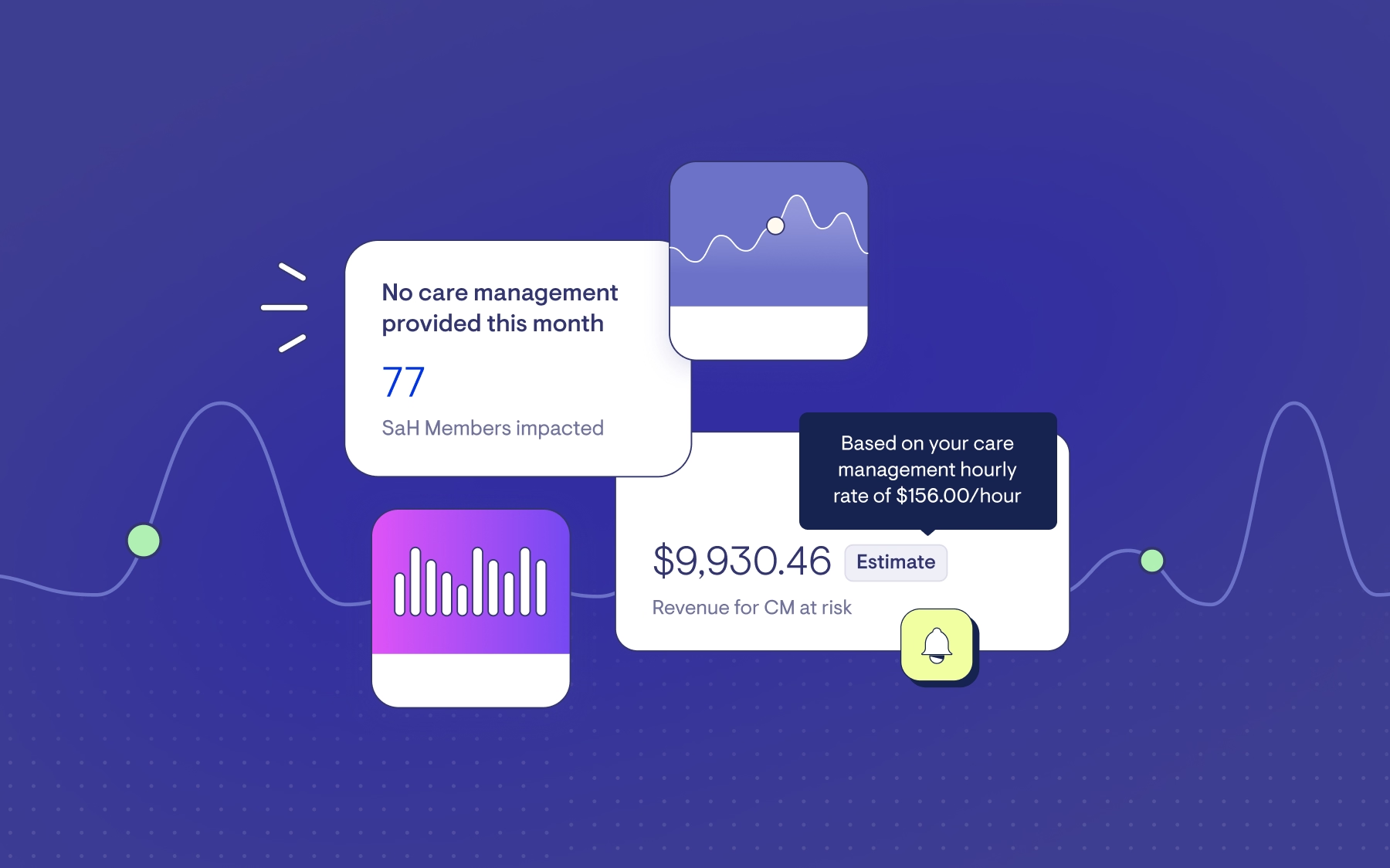
For years, providers have reported on care after the fact. A funding period closes, a report gets submitted, and the numbers speak for themselves, or don't. Support at Home changes that sequence. Transparent charging, proof of service, and single-provider accountability mean providers are no longer just reporting what happened. They're being asked to evidence it, in real time, and be ready to justify it on demand.
That's a materially different exercise. Reporting looks backward. Evidencing has to hold up under scrutiny the moment someone asks.
From reporting to evidencing
The shift sounds subtle, but it changes what "good data" means. A report that shows utilisation, revenue and cost sitting side by side is enough to satisfy a board pack. It isn't enough to satisfy a funding body asking why a service was charged the way it was, or a member asking what they received for their fee. Proof of service means providers need to show the link between what was delivered, what it cost, and what was charged, not just that all three numbers existed somewhere in the system.
Responsibility has also consolidated. Where accountability for an outcome used to sit somewhere across a chain of subcontractors and referrals, it now sits with the registered provider, answerable for the whole picture and everything behind it.
Both changes point the same way: providers now need to have the systems in place to show their work, not just their results.
Where the evidence needs to start
In practice, this accountability gets built in the everyday operational decisions that shape margin and service delivery.
It starts with the roster. Every schedule is a set of decisions about who delivers care, when, and at what cost. Under Support at Home, that roster is no longer just an operational tool. It's part of the evidence trail showing services were delivered as charged, with the right people, at the right time. Get scheduling right, and wage efficiency tends to follow it closely: labour is the largest cost in community care, and providers who can show how their labour spend maps to actual service delivery are in a far stronger position to justify their pricing than those who cannot.
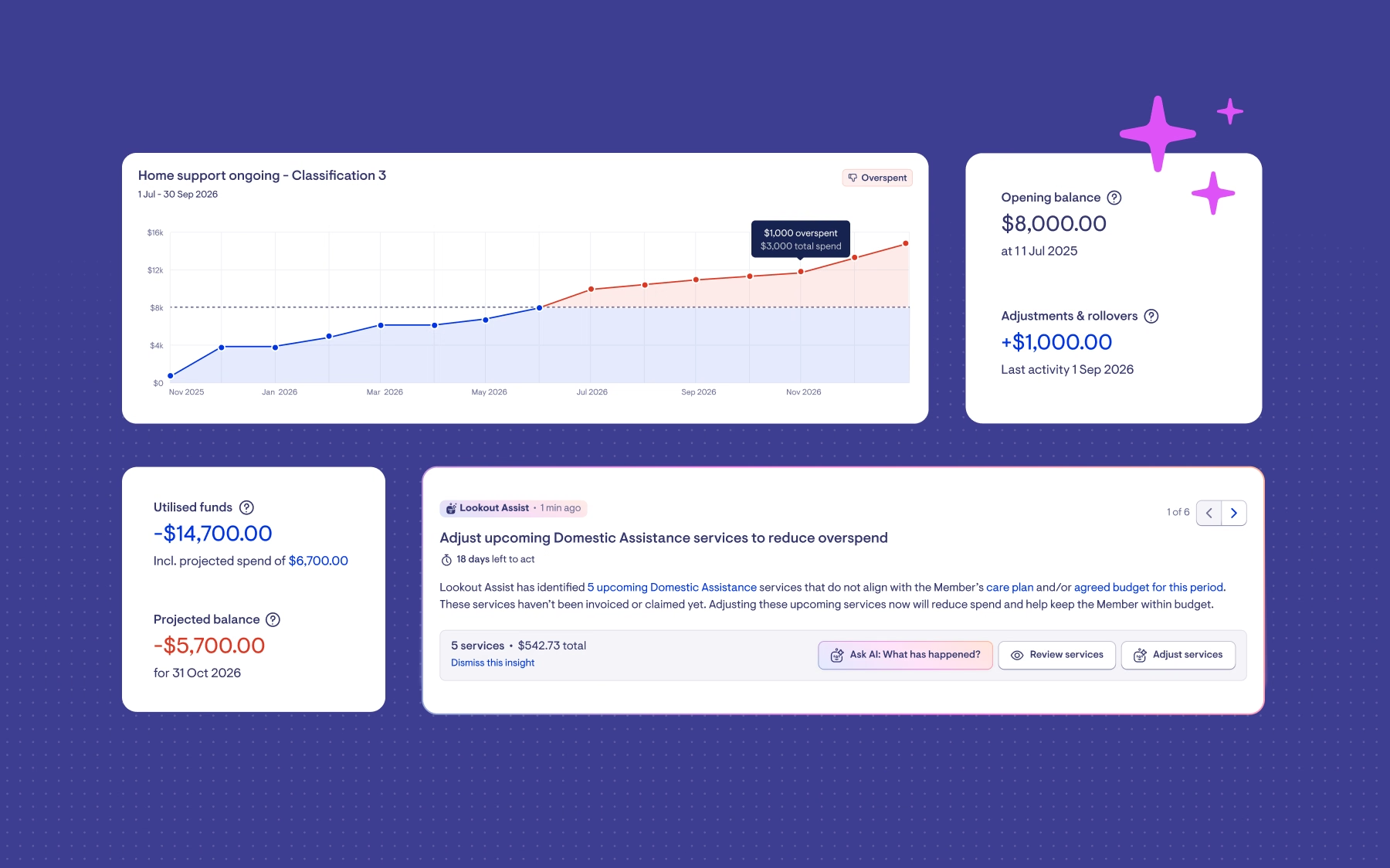
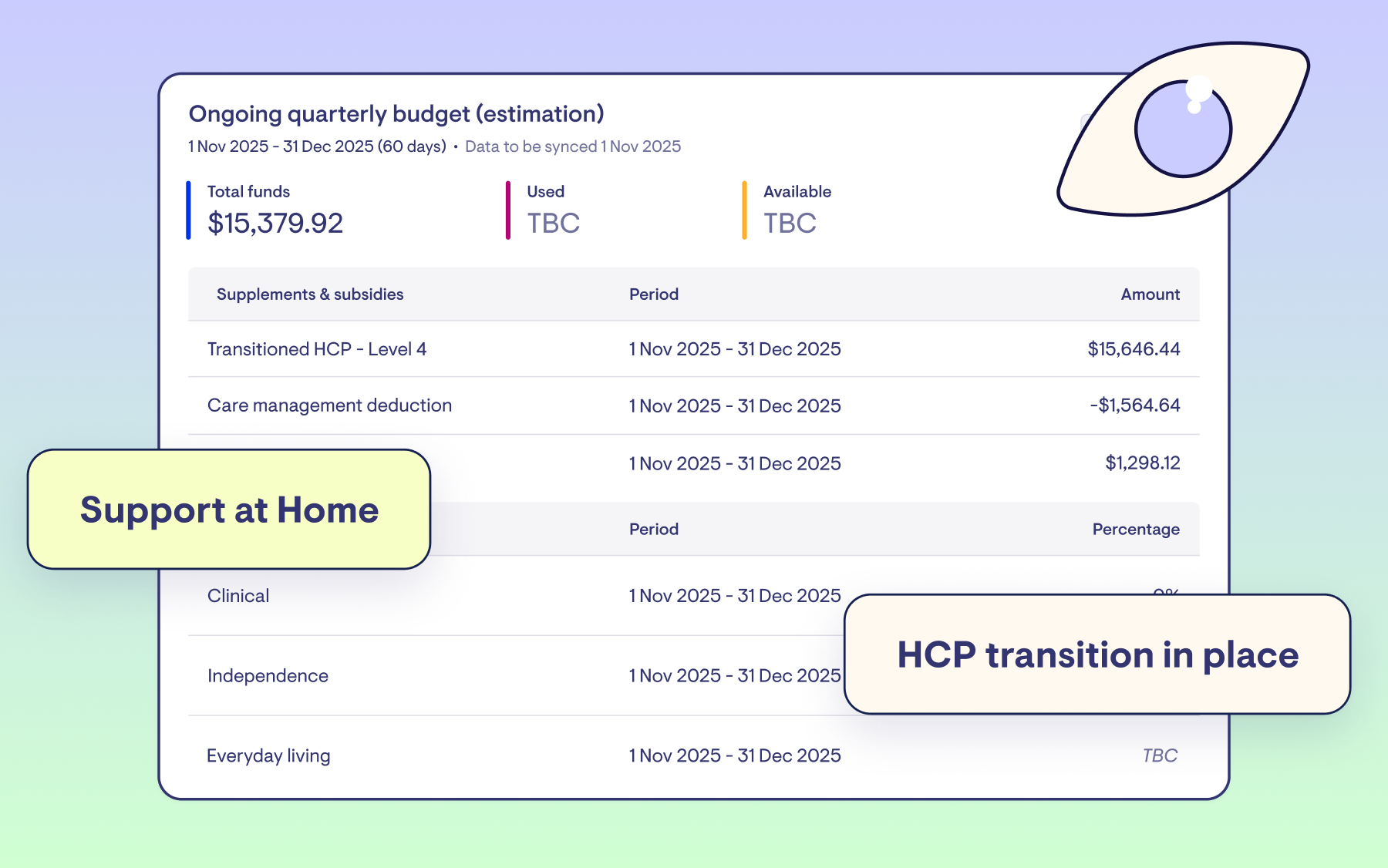
That same clarity needs to extend to funding itself. Support at Home ties subsidy more tightly to what's delivered, so providers need to know with confidence whether available subsidy is being used as intended, underused, or stretched further than it should be, because each of those has very different consequences under a transparency-first model.
Sitting alongside all of it is the exposure most providers feel but rarely quantify: care delivered above what's funded, often for good reason, but rarely tracked with the same rigour as billed services. Under a model built on proof of delivery, that unfunded exposure is a gap where providers are now expected to be most transparent.
The funding paradox is already visible
The most striking pattern in KPI Insight's Economics of Care benchmarking is not simply that some members are underusing their funding. It is that underutilised funding, unfunded care and long waits for care can all exist at the same time.
At the end of the last quarter, the benchmarking cohort had used less than half of available Support at Home subsidy on average. The current quarter is tracking ahead, but the imbalance has not disappeared. Unfunded care exposure has risen 21% quarter-on-quarter, while projected handback risk has increased 29%.
Put those numbers beside the national debate and the accountability equation becomes much harder to ignore. On 26 August, Aged Care Minister Sam Rae told ABC Radio Perth that urgent-priority Support at Home participants receive packages in under a month, high-priority participants wait around one to two months, and standard-priority participants can wait around six to eight months. He put the national priority system at about 100,000 people.
Just nine days earlier, ABC Four Corners' The Waiting Game examined families waiting to be assessed and receive critical funding. The program reported that the median time from applying for care to actually receiving it was ten months and questioned the way the official waitlist is counted, with ABC reporting that more than 150,000 Australians were waiting for some or all of their in-home aged-care funding when people receiving interim funding were included.
The benchmarking does not suggest that underutilised member funding causes the national waiting list, or that an individual member's unspent balance can simply be redirected elsewhere. What it does expose is a broader economic problem: scarce funding and scarce workforce capacity are not always translating into care where and when it is needed.
Some members are receiving care beyond their available funding, while funding allocated elsewhere is at risk of going unused. That is a lost opportunity on both sides of the equation. For providers, the question is no longer just, "How much subsidy do we have?" It is, "Is that subsidy becoming care, for the right member, at the right time?"
For context, KPI Insight's subsidy utilisation measure includes applicable carried-forward member balances, so it measures whether the funding actually available to a member is translating into delivered care.
Winter shows how quickly the operating equation changes
The same evidence trail can be seen much closer to the roster. Across our benchmarking cohort, winter uncovered cancellations were around 30% higher than autumn. Minimum-engagement exposure increased about 20%, broken shifts rose around 14%, and tight transitions between visits fell about 12%. Measures of helper continuity also softened.
That matters because winter absenteeism is not just a staffing problem. When a familiar worker becomes unavailable, the replacement decision can ripple through continuity of care, travel, minimum engagement and the wage cost of the day. Yet providers largely protected overall contribution margin through the period. That makes the point stronger, not weaker: the headline financial result can look stable while the operating conditions underneath it become materially harder.
This is why scheduling, wage efficiency and quality should not be read as separate dashboards. A scheduling decision shapes a wage outcome; it can also shape whether a member sees a familiar worker and whether a service is delivered at all. Under Support at Home, those operational decisions are part of the evidence a provider needs to understand before the month or quarter closes.
The evidence must exist before it's asked for
The organisations best placed for Support at Home will be the ones with a system built to watch these areas continuously. When schedule, wage, subsidy and unfunded-care data are already being tracked as part of how the business runs, the evidence is simply there when it's needed, rather than something to go looking for.
That's exactly the ground Lookout and KPI Insight are exploring together: what it takes for providers to hold, and understand, that evidence before it's ever asked for.
And there is more in the economics than the headline measures. Service design matters too: how long a visit runs, how travel and minimum engagement are absorbed, and how the same service can produce very different margins depending on the roster around it. That's where the next piece in this series goes deeper.
Sources
Australian Government Department of Health, Disability and Ageing — Radio interview with Minister Rae, ABC Radio Perth, 26 August 2026.
ABC Four Corners — The Waiting Game, aired 17 August 2026; and ABC Investigations reporting on the in-home aged-care funding waitlist, 18 August 2026.
Corey Jackson is Director of KPI Insight and has spent 20 years working on the economics of Australia's community care sector.